Pachinko Card Reader Emulator System
Introduction
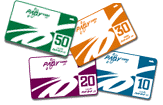
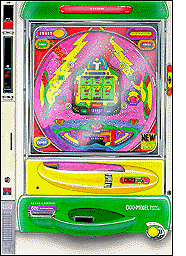
In the Japanese pachinko parlours the game is played by the player purchasing a 'prepaid card'. This card contains the players credit, and when it is inserted into a card reader unit next to the machine, balls can be dispensed directly into the front tray ready to play, with the appropriate amount of credit being deducted from the balance on the card.
|
|
|
Having bought a few pachinko machines for my games room, I was looking to set up a more authentic pachinko parlour style experience, and so wanted one of these prepaid card systems for my own machines. After looking at the cost of importing a genuine parlour prepaid card system, finding that the equipment costs several thousand, and the individual cards have to be bought seperately (and are single use time limited cards), I decided that it was time to design and produce my own system, and this is the result...
History
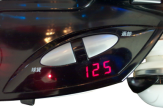
The electrical connections to the pachinko machine were reverse engineered in mid 2006. This was done by dismantling several machines and tracing the connections back to the buttons, display and payout control microprocessor, but this only gave the information about how to read the buttons and display information on the credit display. The complicated part was working out the communication protocol needed to make the pachinko pay out balls on demand, as if a genuine prepaid card unit was connected to the machine.
Decoding the protocol was a long process which was worked on from September through to December 2006. Once the communications were fully understood, work could begin on designing the hardware and software neccesary to make the card reader emulator system.
The first engineering prototype was built in January 2007, and a basic version of the internal software was written to check it's operation. Satisfied with the operation of this prototype, the software was refined and a small run of sample units were built in February and sent out to a number of testers to check that the system was compatible with as many machines as possible.
The production hardware design was completed in March 2007, and the software changes that were needed after feedback from the testers was added and retested, along with software support for the smartcard reader option (which was still a prototype design at this time).
The first production units of the Card Reader Emulator went on sale in early April, while the production design for the smartcard reader option was finalised. The smartcard option was slightly delayed while the equipment needed to print the artwork on the smartcards was obtained, and was first made available for sale at the end of May 2007.